🕵️♂️ A Facebook message claiming to be from “Walt Disney World Investigations” led WDWActiveCrime into a deeper look at Central Florida’s hidden intelligence-sharing network. Public records and conference materials revealed connections involving: How closely do theme parks coordinate with government intelligence networks? Our new investigative series starts now. 👀 Read Part 1 on WDWActiveCrime.com
Cleyton Bray, Walt Disney World Investigations, CFIX, OCSO, and the Public-Private Intelligence Questions Behind Tourism Security
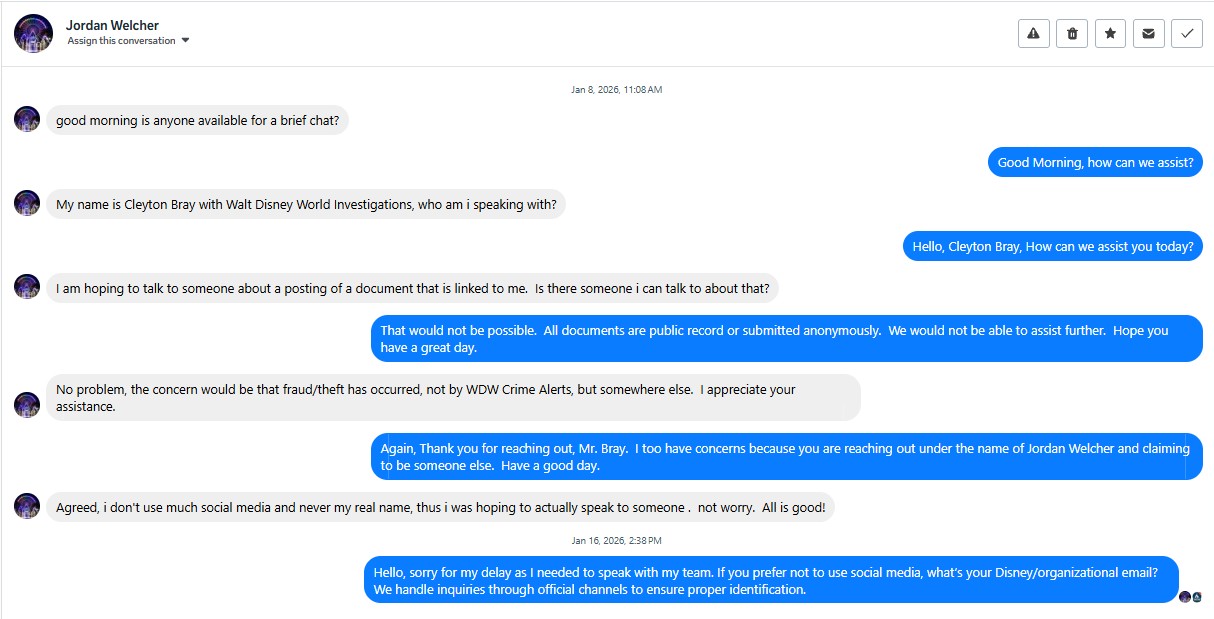
WDWActiveCrime’s review of Central Florida’s private-sector intelligence network began with a Facebook message.
The account was not operating under the name “Cleyton Bray.” It was operating under the name “Jordan Welcher.”
But during the exchange, the person behind the account identified himself as:
“Cleyton Bray with Walt Disney World Investigations.”
That message became the starting point for a broader open-source and public-records review.
WDWActiveCrime could not independently verify whether the Facebook account was genuinely operated by Bray. But the message raised an obvious question: who was this person claiming to be connected to Walt Disney World Investigations, and how did that name connect to Central Florida’s larger intelligence-sharing network?
The search led WDWActiveCrime through publicly available materials, including a 2025 International Association of Crime Analysts speaking bio, prior media references identifying a Lt. Cleyton Bray with the Titusville Police Department, and personnel records requested from Titusville Police.
What emerged was not a simple story about one message.
It was a window into a little-discussed security ecosystem involving a claimed Walt Disney World Investigations connection, Orange County Sheriff's Office (OCSO), CFIX, private-sector intelligence partnerships, and a “Theme Park Intelligence Group.”
Bray’s name matters because it became the thread connecting multiple public-facing records: a Facebook message claiming affiliation with Walt Disney World Investigations, a 2025 International Association of Crime Analysts speaking bio describing a CFIX assignment through OCSO, references to private-sector intelligence leadership, and personnel records from his prior law enforcement career.
That trail opened a larger question about Central Florida’s tourism security ecosystem:
How closely are private theme park intelligence operations connected to government-linked intelligence-sharing networks?
For WDWActiveCrime, the issue is not whether theme parks and law enforcement should coordinate on public safety. They do, and in many situations that coordination is expected.
The issue is visibility.
When public materials describe a private-sector intelligence role connected to CFIX through OCSO, while a separate message claims affiliation with Walt Disney World Investigations, the public has reason to ask how those roles are structured, what information is shared, and what safeguards exist when corporate security interests intersect with government intelligence systems.
The Bio That Raised Bigger Questions
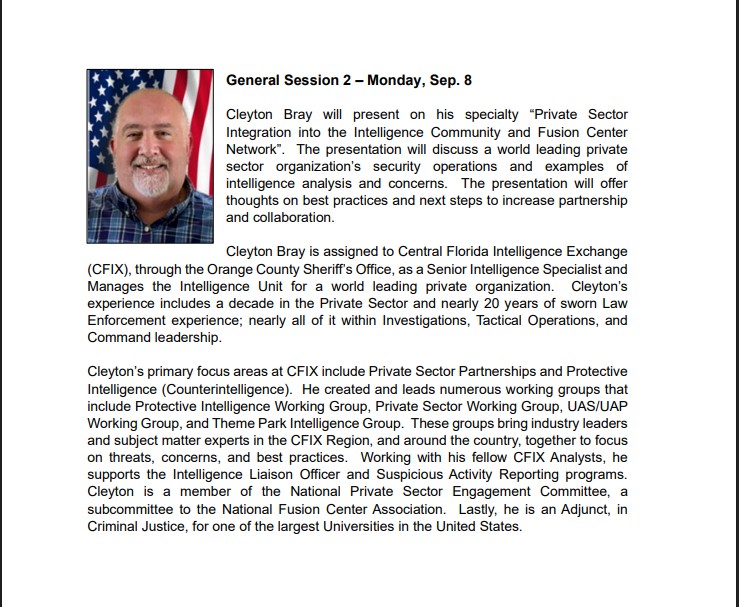
The most significant public description of Bray’s intelligence role appeared in 2025 speaker materials connected to the International Association of Crime Analysts.
That bio identified Cleyton Bray as a Senior Intelligence Specialist assigned to the Central Florida Intelligence Exchange through the Orange County Sheriff’s Office.
The same bio also stated that Bray manages the intelligence unit for a “world leading private organization.”
The bio, as reviewed by WDWActiveCrime, did not name Disney in that specific line. But the wording became significant because of the separate Facebook message claiming Bray was with Walt Disney World Investigations.
The Facebook message claimed a Walt Disney World Investigations affiliation.
The Bio publicly described him as assigned to CFIX through OCSO while also managing intelligence operations for a major private-sector organization.
That overlap is the heart of the story.
There is nothing inherently unlawful about public-private security partnerships. Major private-sector organizations routinely coordinate with law enforcement, emergency management, and homeland security partners, especially around crowded venues, critical infrastructure, and high-profile public spaces.
But the Bray materials raise sharper questions about how those relationships are structured.
Was the role primarily private-sector? Was it primarily connected to CFIX? Was it a public-private assignment? What organization supervised the work? What information moved between the private-sector side and the government side?
Those are not accusations.
They are transparency questions.
And in Central Florida, where private theme parks operate at massive scale while also coordinating with law enforcement and homeland security partners, transparency matters.
CFIX, OCSO, and the Disney Question
The Central Florida Intelligence Exchange, commonly known as CFIX, functions as Central Florida’s regional fusion center.
Fusion centers were created across the United States after the September 11 attacks to improve information sharing between local, state, federal, and private-sector partners.
The 2025 IACA materials did not describe a routine security role. They described work involving private-sector partnerships, protective intelligence, counterintelligence, suspicious activity reporting, intelligence liaison programs, and theme park-focused intelligence coordination.
For most theme park guests, those terms are far removed from the visible version of security: bag checks, uniformed officers, cameras, trespass warnings, and emergency response.
They are the language of intelligence-sharing, threat assessment, protective intelligence, and public-private coordination.
That alone is not unusual.
But it does mean the relationship deserves scrutiny.
The question is not whether Disney, OCSO, or CFIX should cooperate on public safety. Major venues and law enforcement agencies do coordinate, and in many situations they should.
The better question is this:
When a private-sector intelligence role is described alongside a government-linked fusion center assignment through a sheriff’s office, where does corporate security end and government intelligence begin?
The Theme Park Intelligence Group
One of the most striking references in the public materials reviewed by WDWActiveCrime was the Theme Park Intelligence Group.
The name alone raises obvious questions.
What agencies or companies participate?
What information is shared?
What threats are discussed?
Are suspicious activity reports involved?
How much of this activity is documented in public records, and how much remains inside private corporate systems?
The materials described Bray as creating and leading multiple working groups, including the Theme Park Intelligence Group, the Private Sector Working Group, and the Protective Intelligence Working Group.
For supporters of these partnerships, that may sound like responsible security planning in a region filled with crowded, high-profile venues.
For critics, it raises a different concern: private theme park security is no longer just about cameras, bag checks, and trespass warnings.
It is increasingly connected to intelligence analysis, fusion-center coordination, and public-private information sharing.
That is the hidden infrastructure most guests never see.
Why Theme Parks Are Part of the Intelligence Conversation
Central Florida’s tourism corridor is unlike almost anywhere else in the country.
Walt Disney World, Universal Orlando, SeaWorld, major hotels, entertainment districts, convention spaces, and transportation routes bring millions of people into a concentrated geographic area every year.
These are not just entertainment venues.
They are crowded, high-profile, economically significant environments.
Modern security operations around those environments increasingly involve intelligence analysis, behavioral threat assessment, protective intelligence, suspicious activity reporting, online threat monitoring, emergency planning, and interagency coordination.
Supporters argue these tools are necessary because the threats are real.
Critics argue the tools can create a growing surveillance environment where private corporate security systems and government intelligence networks become harder to separate.
Both views can exist at the same time.
A major theme park may have legitimate reasons to protect its guests, employees, property, and operations.
The public also has legitimate reasons to ask what information is shared when private intelligence operations interact with government-linked fusion centers.
Bray’s Prior Law Enforcement Background
The public-records review also led WDWActiveCrime to Bray’s prior law enforcement history.
Before becoming publicly associated with CFIX’s private-sector intelligence integration efforts, Cleyton Bray served with the Titusville Police Department.
Public records reviewed by WDWActiveCrime show Bray was the subject of an Internal Affairs investigation identified as “0263-IA.” The matter initially resulted in a three-day suspension and a demotion from lieutenant to police officer.
The matter was later resolved through a settlement agreement.
Settlement documents show the case became part of an agreement involving the City of Titusville and the Fraternal Order of Police. Under that agreement, Bray’s lieutenant rank was reinstated retroactively, the sustained findings were converted to “Not Sustained,” and Bray agreed to resign effective September 7, 2014.
A separate resignation document states:
“I Lieutenant Clayton [sic] Bray hereby resign from the Titusville Police Department effective September 7, 2014.”
The settlement agreement stated that neither party admitted wrongdoing.
From 2014 to 2019 little is publicly documented about Bray’s professional path.
The same public-facing 2025 bio also described Bray as an adjunct in Criminal Justice for one of the largest universities in the United States. Public payroll data reviewed by WDWActiveCrime lists Cleyton Bray in connection with the University of Central Florida as early as 2019, and again in 2023, when he was listed as an instructor with reported pay of $3,555.56. A Rate My Professors page also appears to associate Bray with CJE 3001, “Careers in Criminal Justice,” with reviews appearing as recently as 2023. WDWActiveCrime did not locate Bray on UCF’s current Criminal Justice faculty page.
The records do not answer how Bray’s later intelligence-sector roles were vetted, supervised, or structured. But they do add context to his later appearance in public-facing materials tied to CFIX, private-sector intelligence integration, protective intelligence, suspicious activity reporting, and theme park-focused intelligence coordination.
Because fusion centers and private-sector intelligence partnerships operate in areas involving public trust, information sharing, privacy, and law-enforcement access, questions about vetting, supervision, and role structure are legitimate matters of public interest.
Bray’s path from local law enforcement to private-sector intelligence integration does not answer those questions on its own.
But it is part of the record.
And it helps explain why a Facebook message claiming to be from “Walt Disney World Investigations” ultimately led WDWActiveCrime into a broader review of CFIX, OCSO, private-sector intelligence integration, and the hidden security infrastructure surrounding Central Florida tourism.
What Information Could Be Shared?
The public concern is not simply that Disney or other theme park operators work with law enforcement.
That cooperation is expected.
The more important question is what types of information may move through public-private intelligence partnerships.
A major tourism operator may maintain or access information such as hotel reservation data, ticketing records, trespass records, surveillance footage, incident reports, access-control logs, vehicle information, security observations, employee reports, and threat-related information.
Most of that information exists for ordinary business, safety, and security reasons.
But when private-sector security operations intersect with law enforcement or fusion-center systems, ordinary corporate information can become valuable intelligence.
That raises questions the public rarely gets to ask:
What information is shared? Who approves the sharing? Is legal process required? Does the information become part of a government record? How long is it retained? Who can access it later?
And what safeguards exist when private-sector intelligence professionals operate inside or alongside government-linked intelligence networks?
Those questions do not imply unlawful conduct.
They are accountability questions.
When a Major Arrest Raises Unanswered Questions
Most public-private intelligence coordination is invisible to the public.
Occasionally, however, a major criminal case raises questions about how private tourism systems and law enforcement operations may intersect.
One recent example involved the arrest of a California fireworks company owner wanted in connection with a deadly warehouse explosion that killed seven people.
According to media reports, the suspect, who was facing murder charges tied to the explosion, was arrested at Walt Disney World before appearing in an Orange County courtroom pending extradition to California.
WDWActiveCrime found no public record establishing how law enforcement located him on Disney property.
That unanswered detail is exactly why the broader public-private intelligence question matters.
Did law enforcement already know where he would be?
Did investigators contact Disney before the arrest?
Did Disney know the arrest was going to occur?
Were any Disney-controlled systems requested or used to confirm his location?
Was the arrest based entirely on law enforcement information obtained outside Disney?
Those questions do not imply improper conduct by Disney or law enforcement.
They highlight the reality that major theme park operators maintain extensive operational systems that can show where guests plan to be, when they enter a park, what reservations they hold, and how they move through parts of the resort.
Most guests provide accurate identifying information when booking hotels, creating accounts, buying tickets, or making park-related plans. Few would expect that ordinary vacation data could ever become relevant to a criminal investigation.
In cases involving wanted persons, violent crimes, terrorism concerns, missing persons, or public safety threats, many people would expect private security teams and law enforcement to coordinate quickly.
But the public-interest question remains:
What rules govern that coordination?
When is legal process required?
Who decides what information is shared?
And when private corporate systems can help locate a person in one of the most visited entertainment destinations in the world, what oversight exists to ensure the process is properly documented?
The issue is not whether Disney should help law enforcement in legitimate public-safety situations.
The issue is whether the public understands how that system works, what safeguards exist, and where the line is drawn between routine cooperation and intelligence sharing.
The Accountability Gap
Public law enforcement agencies are subject to public records laws, constitutional limits, court oversight, and open-government requirements.
Private companies are not subject to the same level of transparency.
That creates an accountability gap.
If OCSO maintains a record, the public may be able to request it.
If Disney maintains similar information internally, the public usually cannot.
If a fusion center receives information from a private-sector partner, the public may not know what was submitted, how it was analyzed, who received it, how long it was retained, or whether it was used later.
That does not mean the information sharing is improper.
But it does mean the public has limited visibility into a system that may involve both private corporate data and government intelligence infrastructure.
For Central Florida, where private entertainment venues function as major tourism infrastructure, that gap deserves scrutiny.
Outstanding Records Requests
As part of its reporting, WDWActiveCrime previously submitted public records requests in January 2026 to the Orange County Sheriff’s Office seeking records related to CFIX structure, personnel, and public-private intelligence coordination.
As of publication, those requests had not been fulfilled.
The pending records may provide additional context about how CFIX-related personnel, working groups, and private-sector intelligence partnerships are structured, documented, and retained.
Until those records are produced, the public record remains incomplete.
The central unanswered question remains how private-sector intelligence roles are structured when they operate alongside, inside, or through government-linked fusion-center systems.
Why This Matters
This story is not only about Bray.
It is about the modern security system surrounding Central Florida tourism.
Most guests visiting Walt Disney World will never think about fusion centers, suspicious activity reports, intelligence liaison programs, protective intelligence, or private-sector working groups.
They see the park entrance, the hotel lobby, the fireworks, the rides, and the carefully managed public-facing version of the resort.
Behind that public-facing experience is a security network built for a post-9/11 world — one that increasingly connects private entertainment companies with law enforcement agencies and intelligence-sharing systems.
To supporters, that network is necessary to protect millions of visitors.
To critics, it represents another step toward a security environment where private corporate data and government intelligence operations become harder to separate.
Either way, the public deserves to understand that the system exists.
And one question remains at the center of WDWActiveCrime’s review:
How closely are private theme park intelligence operations connected to Central Florida’s government-linked intelligence-sharing network?
Coming in Part 2: Where Corporate Security Meets Government Intelligence
WDWActiveCrime will examine Suspicious Activity Reporting programs, information sharing between private companies and law enforcement, privacy concerns surrounding modern intelligence operations, and the legal boundaries between corporate security and government intelligence systems.