🎢 Florida Theme Park Ride Injury Report (Q4 2025) The state’s latest MOU-exempt report shows ride-related medical incidents at Disney World and Universal from Oct–Dec 2025. No mechanical failures are alleged—only initial medical assessments. Why Florida doesn’t inspect major theme park rides 👇
Editorial Note
WDWActiveCrime continues to track and contextualize public safety data across Central Florida’s theme parks. As with all reporting, presence on this list does not imply wrongdoing by guests or operators.
Florida’s fourth-quarter theme park injury report has been released, covering incidents reported between October and December 2025. The data comes from the state’s MOU-Exempt Facilities Report, which applies to large theme park operators that are exempt from routine state ride inspections.
The report reflects initial medical assessments only. Due to privacy restrictions, the Florida Department of Agriculture and Consumer Services does not receive follow-up updates regarding a guest’s condition after the incident.
What Is an MOU-Exempt Facility?
Large Florida theme parks operate under a Memorandum of Understanding (MOU) with the state. These facilities are exempt from routine state ride inspections and instead self-report qualifying medical incidents that occur on or immediately after attractions.
The report does not determine fault, mechanical failure, or causation. It documents what was reported at the time of the incident, often including guest age, gender, and whether a pre-existing condition was noted.
Fourth Quarter 2025 Incident Summary
(October–December 2025)
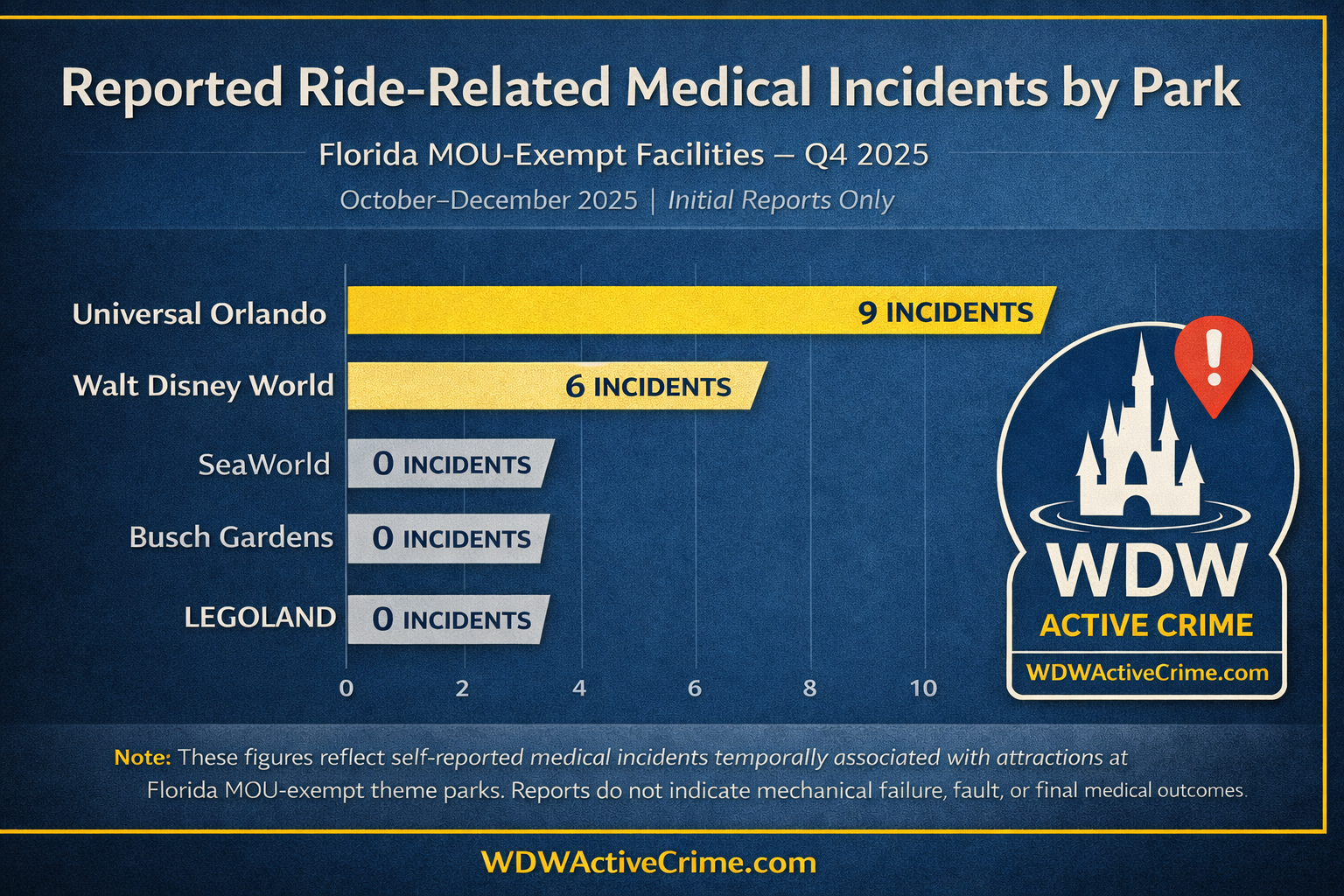
SeaWorld
- None reported
Busch Gardens
- None reported
LEGOLAND
- None reported
Walt Disney World
- 10/28/25 – Peter Pan’s Flight
65-year-old female; chest pain after the attraction - 11/12/25 – Guardians of the Galaxy: Cosmic Rewind
72-year-old male; disorientation after exiting (pre-existing illness) - 11/22/25 – Mad Tea Party
42-year-old male; seizure during the attraction - 11/23/25 – Test Track
59-year-old female; breathing difficulties while exiting (pre-existing condition) - 11/28/25 – Slinky Dog Dash
75-year-old male; stroke-like symptoms during the attraction (pre-existing condition) - 12/28/25 – The Seas with Nemo and Friends
35-year-old female; loss of consciousness during the attraction (pre-existing condition)
Universal Orlando Resort
- 10/04/25 – Monsters Unchained: The Frankenstein Experiment
41-year-old female; numbness and visual disturbance (pre-existing condition) - 10/06/25 – Stardust Racers
78-year-old male; chest pain - 10/13/25 – The Incredible Hulk Coaster
45-year-old female; motion sickness and stroke-like symptoms - 10/14/25 – Stardust Racers
61-year-old male; cardiac arrest - 10/25/25 – Mario Kart: Bowser’s Challenge
19-year-old female; altered mental status - 11/14/25 – Yoshi’s Adventure
47-year-old male; nausea - 11/23/25 – Doctor Doom’s Fearfall
61-year-old male; lower back spasm - 11/25/25 – Revenge of the Mummy
70-year-old female; unresponsive, later passed away at the hospital - 11/30/25 – Jurassic World: VelociCoaster
49-year-old female; chest pain
Why Doesn’t Florida Inspect Major Theme Park Rides?
Florida does inspect carnival rides, fairs, and smaller attractions, but the state treats large theme parks differently due to a law dating back to the late 1980s.
The Core Reasons:
1. Political and Economic Influence
Major theme parks are among Florida’s largest employers and economic drivers. The exemption was designed to reduce regulatory friction for companies with extensive internal safety programs.
2. Internal Safety Infrastructure
Disney and Universal employ:
- Full-time ride engineers
- In-house safety inspectors
- Redundant daily, weekly, and seasonal ride checks
- Embedded emergency response teams
The state determined these systems met or exceeded external inspection standards.
3. Legal Structure
Instead of inspections, Florida requires:
- Mandatory reporting of serious ride-related medical incidents
- Immediate notification of fatalities
- Documentation available for state review
4. Liability Still Exists
The exemption does not protect parks from:
- Civil lawsuits
- OSHA investigations
- Criminal negligence charges
- Federal scrutiny in fatal cases
What This Report Does, and Does Not, Show
This report shows:
- Medical incidents temporally associated with rides
- Demographic information
- Whether pre-existing conditions were noted
This report does not show:
- Mechanical failures
- Ride malfunctions
- Operator error
- Final medical outcomes
- Fault or causation
Most reported incidents involve medical events rather than ride defects, particularly cardiac, neurological, or consciousness-related episodes.
Why These Reports Still Matter
While often misunderstood, MOU injury reports provide:
- Transparency into serious guest medical events
- Data trends over time
- Public accountability for exempt facilities
They are one of the few publicly available windows into ride-adjacent medical emergencies at Florida’s largest theme parks.