Being “trespassed” from Disney property isn’t a temporary warning. It’s a legally enforceable removal of access. This article explains what a Disney trespass really means under Florida law, why bans don’t expire on their own, and what most guests never realize about the limited and uncertain process to request a lift.
What “Getting Trespassed” at Disney Really Means and What It Takes to Come Back
For many guests, being “trespassed” from Disney property sounds like a temporary inconvenience. A bad night. A warning. Something that blows over once emotions cool down.
In reality, a Disney trespass is far more serious and far more permanent than most people realize.
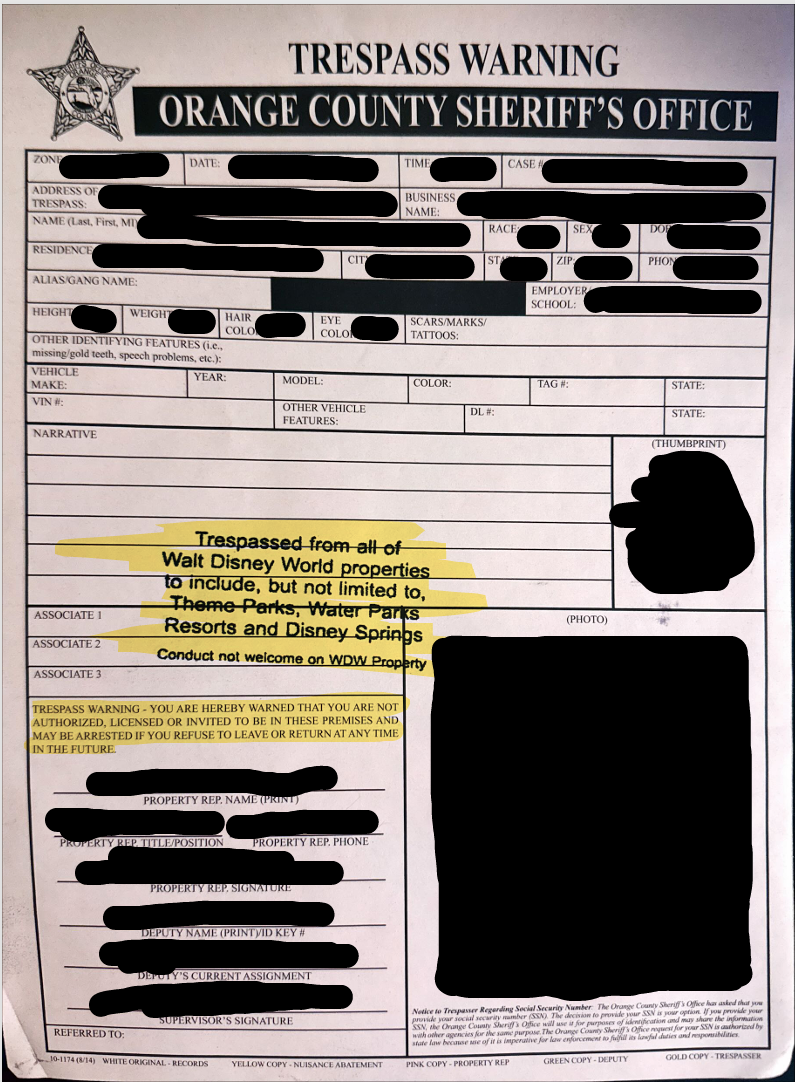
At Walt Disney World Resort, a trespass warning is not just a house rule or a private security decision. It is a legally recognized removal of permission to be on the property. Ignore it, and what began as a policy issue can quickly turn into a criminal charge under Florida law.
What follows is not legal advice, but practical, experience-based information about how Disney trespass enforcement actually works and what people almost never understand about trying to get a ban lifted.
A Disney Trespass Is a Legal Line, Not a Suggestion
Disney operates under Florida’s criminal trespass statute. While guests are generally welcome across vast areas of Disney-controlled property, that access exists only as long as permission remains in place.
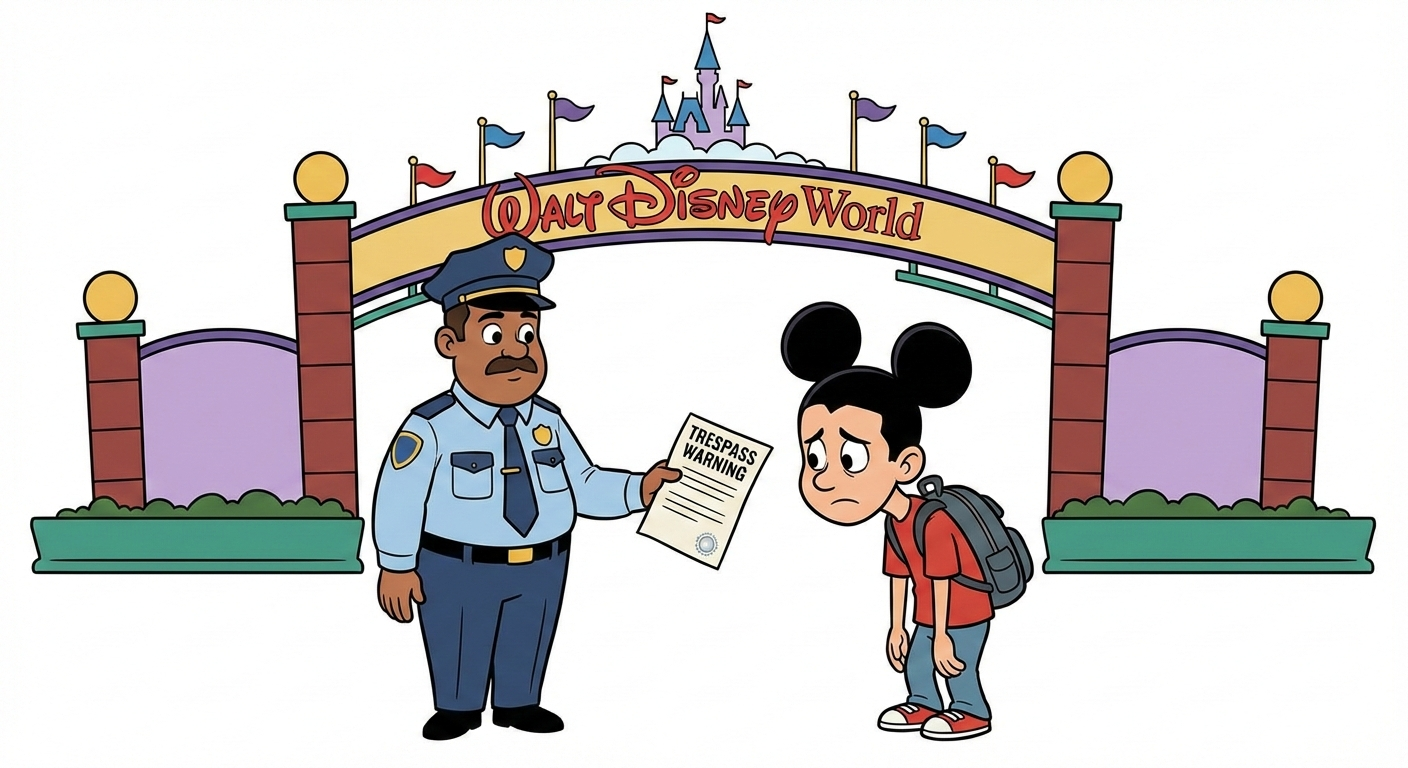
When Disney Security issues a trespass warning, often with an Orange County Sheriff’s Office deputy present, that permission is formally revoked.
At that point:
- You are no longer lawfully authorized to remain on Disney property
- You are expected to leave immediately
- Returning later is not a “second warning” scenario
If you come back after being trespassed, the next encounter is no longer discretionary. It is a clean trespass violation, and in many cases results in arrest rather than removal.
This is where many people make their most costly mistake: assuming time alone fixes the problem.
The Trespass Does Not Automatically Expire
One of the most common misconceptions is that Disney trespass warnings “fall off” after a set amount of time.
They do not.
There is no automatic expiration date. There is no countdown clock that resets your access. If you were trespassed, you remain trespassed until Disney affirmatively lifts it.
That matters because people who return believing a year has passed, without confirmation, often learn the hard way that nothing changed.
The One-Year Reality: When Disney Will Even Listen
Here is where insider knowledge matters.
While Disney does not publish a public policy on trespass reversals, enforcement patterns are consistent enough to draw clear conclusions:
- Requests made too soon are rarely considered
- A minimum waiting period of approximately one year is common before Disney will even review a lift request
- The waiting period typically starts from the date the trespass was issued, not when a court case ends
This is not a guarantee of review and only a baseline for consideration.
Requests sent earlier are often ignored or denied without explanation.
There Is Only One Path to a Lift and It’s Not Guest Services
Another widespread misunderstanding is who can undo a Disney trespass.
- Law enforcement cannot lift it
- A judge cannot lift it
- Paying fines or completing probation does not lift it
- Guest Services cannot lift it
- Calling Disney will not lift it
The only known path is a written request addressed to Disney’s internal security leadership, typically reviewed by or under the authority of the Director of Security.
There is no public-facing form. No appeal hearing. No guaranteed response.
This is not an appeal process in the legal sense. It is a discretionary reconsideration controlled entirely by Disney.
Approval Is Not About Arguing It’s About Trust
People often assume the key to a successful request is making a legal argument or explaining why the trespass was unfair.
That approach usually fails.
Based on observed outcomes, Disney appears to weigh factors such as:
- Time elapsed since the incident
- Whether the incident involved violence, threats, or alcohol
- Whether the individual complied when ordered to leave
- Whether there is any history of similar incidents
- Whether responsibility is acknowledged rather than deflected
What does not tend to help:
- Blaming security or law enforcement
- Claiming ignorance of the rules
- Threatening legal action
- Treating the process like a customer service complaint
Disney is not deciding whether the trespass was technically correct. They are deciding whether reinstating access presents a risk they are willing to accept.
Silence or Denial Is Common and Final
Even well-written, respectful requests may:
- Be denied without explanation
- Receive no response at all
- Take weeks or months to be reviewed
A lack of response should be treated as a denial, not an invitation to return.
Attempting to test the boundary by showing up “just to see” is one of the fastest ways to turn a prior warning into a new criminal case.
The Bottom Line
Being trespassed from Disney property is not a slap on the wrist. It is a formal, enforceable removal of access under Florida law.
Getting that access back is:
- Slow
- Discretionary
- Uncertain
- Entirely controlled by Disney
The most important takeaway is simple:
If you are trespassed, assume it is permanent unless you receive explicit confirmation otherwise.
Anything else is a gamble and one that often ends with handcuffs instead of fireworks.