A guest arrested at Disney’s Animal Kingdom in December 2025 was originally issued a trespass warning in 2019, highlighting how Disney bans remain enforceable years later and why returning without clearance can carry serious consequences.
On the morning of December 23, 2025, a trespass arrest at Disney’s Animal Kingdom quietly reinforced one of the most misunderstood aspects of Disney property bans: a trespass warning does not simply “expire” with time.
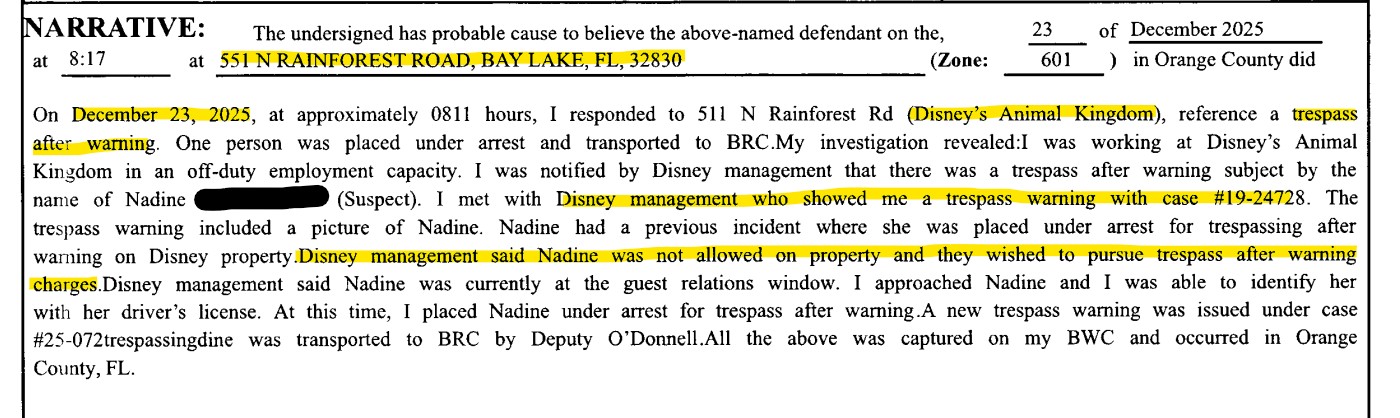
At approximately 8:11 a.m., an off-duty Orange County deputy working security at Disney’s Animal Kingdom responded to a report of a trespass after warning involving a guest identified as Nadine. Disney management alerted the deputy that the individual had an active trespass warning on file, originally issued in 2019and was not authorized to be on Disney property.
How the Trespass Was Identified
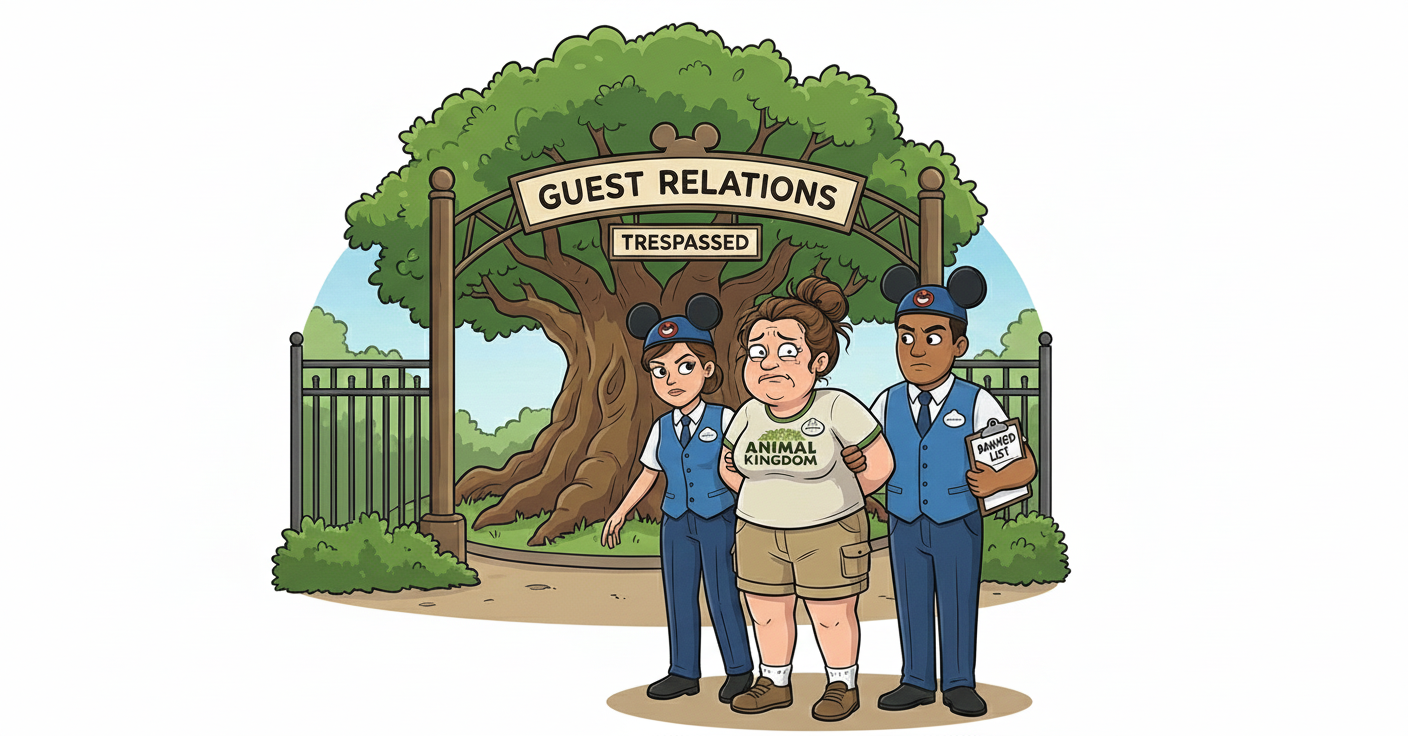
According to the arrest report, Disney management produced a prior trespass warning associated with case from 2019, which included a photograph of the individual. The suspect was located at the Guest Relations window and was positively identified using a driver’s license.
Disney management confirmed that the subject was not permitted on property and requested enforcement. The deputy then placed her under arrest for trespass after warning. She was transported to the Orange County Booking and Release Center (BRC). A new trespass warning was issued, effectively resetting the enforcement record.
All actions were documented via body-worn camera and occurred within Orange County, Florida.
Why This Case Matters
This arrest closely mirrors the real-world scenarios discussed in your broader trespassing article and serves as a textbook example of how Disney handles enforcement years later.
Key takeaways reinforced by this case:
- Time alone does not invalidate a trespass warning
The original warning was issued in 2019. Six years later, it was still enforceable. - Disney maintains internal records, including photos
Identification was made using Disney’s documentation before law enforcement action occurred. - Returning without formal clearance can lead directly to arrest
There was no verbal dispute, disturbance, or confusion, just presence on property. - A new trespass warning compounds the situation
Each enforcement action strengthens Disney’s internal justification for continued denial of access.
The Bigger Picture: Why People Get Caught Years Later
Many individuals believe that if enough time passes, or if they return quietly, they will not be noticed. In practice, that assumption is risky.
Disney frequently identifies previously trespassed individuals through:
- Guest Relations interactions
- Ticketing or ID checks
- Security referrals
- Prior incident photos tied to internal case numbers
Once identified, the decision to pursue charges is entirely Disney’s. Law enforcement then acts on that request.
Connecting Back to the Trespass Lift Discussion
As outlined in your larger trespassing explainer, the only realistic path forward after a Disney trespass warning is patience and formal process, not assumption.
This arrest underscores why the commonly cited “wait a year and write a letter” guidance exists at all. Even then, approval is discretionary, undocumented publicly, and never guaranteed. Showing up without confirmation does not test the system, it triggers it.
Why This Arrest Shouldn’t Be Dismissed
This December 2025 arrest at Disney’s Animal Kingdom is not remarkable because of what happened, it is notable because of how little had to happen for it to occur.
No disturbance.
No confrontation.
No misunderstanding about where the individual was.
The only factor that mattered was the existence of a prior trespass warning from years earlier.
Cases like this are exactly why Disney trespass warnings continue to surprise people long after they are issued. Many assume time, good behavior, or a quiet return will be enough. In reality, Disney maintains internal records, including photographs and case numbers, and can request enforcement at any point if a previously warned individual is identified on property.
This arrest illustrates the practical risk of relying on assumptions instead of confirmation. It also reinforces why informal advice and internet myths about Disney trespasses routinely fail people in real-world situations.
For a deeper breakdown of how Disney trespass warnings work, why they do not automatically expire, and what the realistic, though uncertain, path looks like for requesting a lift, see the full explainer: Getting Trespassed at Disney: What Actually Happens, and What Comes Next.
That article provides the broader context this arrest fits into, and explains why showing up unannounced is often the worst possible test of whether a ban is still in place.